
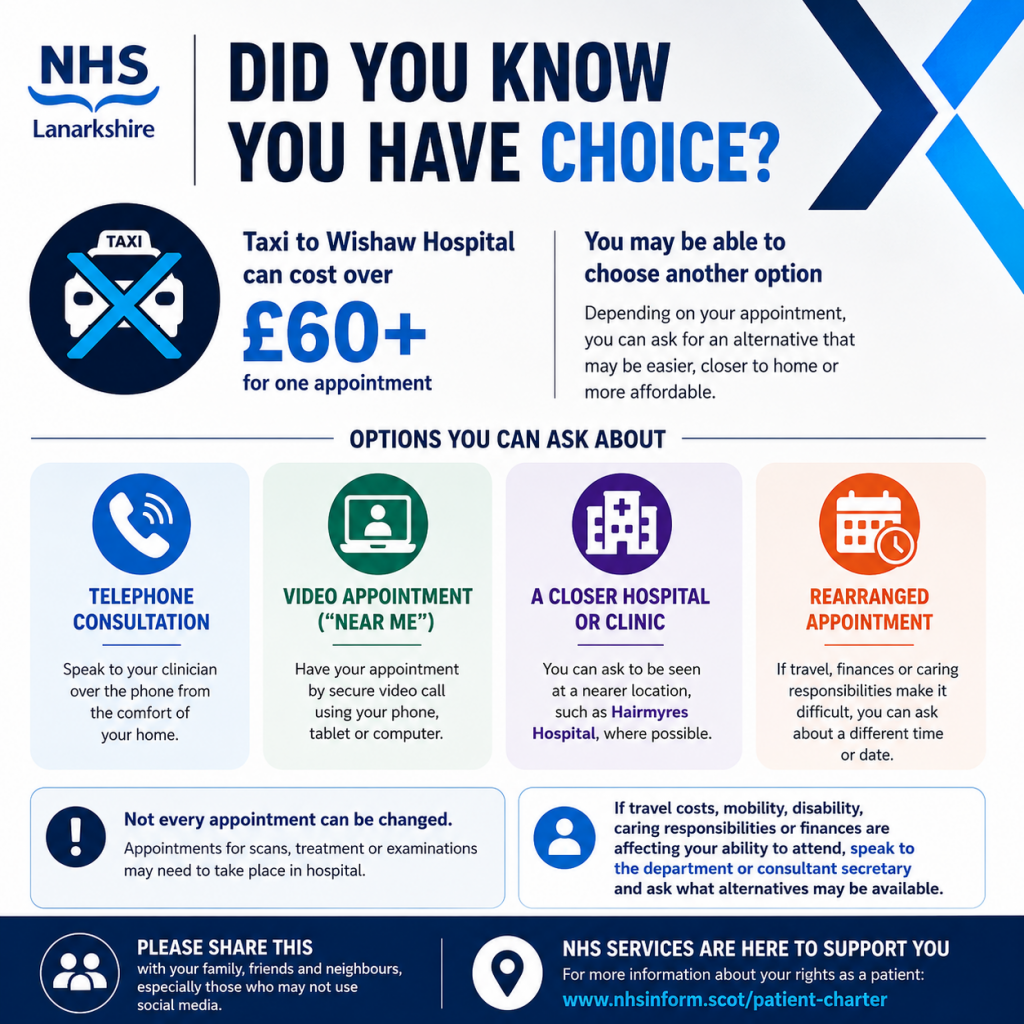
YOUR rights as patient and simplified guide as we have got so many queries regarding people receiving appointment letters for wishaw when that particular clinic runs at hairmyres also. – Please share to help friends/family and loved ones your rights enshrined in law.
As the cost of living crisis continues to place pressure on households across Scotland, growing concerns are now being raised around the hidden financial burden many patients face simply attending NHS hospital appointments.
Residents across East Kilbride and Lanarkshire have contacted The Community Impact / East Kilbride Neighbourhood Watch describing long journeys, expensive taxi fares, multiple bus connections and confusion surrounding whether alternative appointment options were available to them.
What we are hearing:
In some cases, patients travelling to University Hospital Wishaw without access to a car could face taxi fares exceeding £60 for a single appointment depending on location, waiting times and return travel.
For many elderly residents, carers, disabled patients and low income households, attending hospital is not simply a matter of “getting there”. It can involve coordinating lifts from family members, lengthy public transport journeys, taking unpaid time off work, arranging replacement care, or physically navigating difficult travel routes while already unwell.
Some residents described journeys involving multiple buses across Lanarkshire for relatively short consultations that they believed could potentially have been carried out by telephone or video appointment.
Carers also highlighted the additional pressure placed on families when vulnerable relatives require accompaniment to appointments far from home. For those caring for individuals with dementia, mobility issues, autism, learning disabilities or chronic illness, lengthy travel can cause distress, confusion and exhaustion long before an appointment even begins.
Community volunteers involved in local advocacy work say many patients appear unaware that, depending on clinical suitability, they may be able to ask about alternatives including telephone consultations, video appointments through NHS Near Me services, or attendance at a hospital geographically closer to home such as University Hospital Hairmyres.
The issue has sparked wider discussion around patient awareness, communication and whether enough information is proactively provided to residents navigating increasingly stretched NHS systems.
Your Rights As A Patient
Under NHS Scotland’s Charter of Patient Rights and Responsibilities, patients have rights relating to communication, involvement in decisions and participation in their care.
The Charter states patients have the right to:
“Be involved in decisions about your care and treatment.”
While clinical decisions must always remain with healthcare professionals and patient safety must come first, campaigners argue many residents are simply unaware they can ask questions about whether flexibility exists around how and where appointments take place.
Several residents who spoke with The Community Impact described automatically accepting appointments at hospitals further from home because they believed there was “no alternative”.
Others said they were unaware that some follow up consultations, medication reviews or discussions could potentially be handled remotely where clinically appropriate.
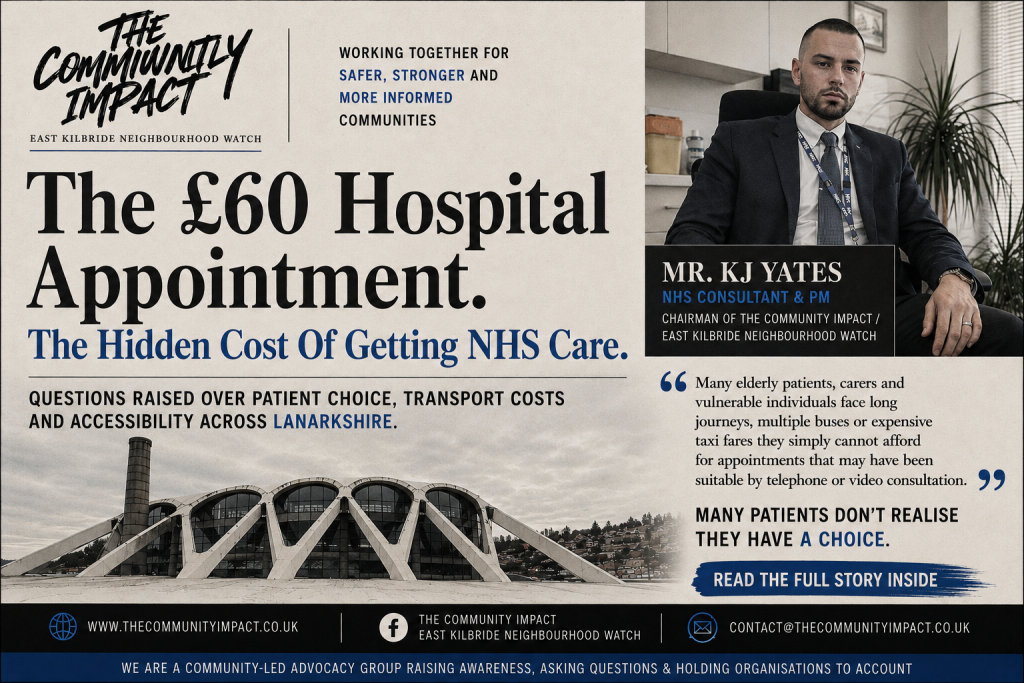
Mr. KJ Yates, NHS Consultant, PM and Chairman of The Community Impact / East Kilbride Neighbourhood Watch, said:
You should ask if you cannot afford/or its not possible to get to an alternative clinic outside of EK if you need to be there in person. If you do not need an examination you have more options and always ask if you can book elsewhere such as Hairmyres
“As somebody who has worked within health and social care across both private and NHS care and Primary Care, operational management and patient advocacy, this genuinely worries me. The reality is that elderly patients, carers and vulnerable individuals are statistically far more likely to live with multiple long term conditions, mobility difficulties, disability or financial hardship. Evidence across health and social care consistently shows these groups are also more likely to experience deprivation, social isolation and barriers to accessing services. When somebody already struggling physically, emotionally or financially is expected to navigate multiple buses, lengthy travel times or potentially £60 plus taxi fares for appointments that may clinically have been suitable by telephone or video consultation, that is not truly patient centred care. In several cases where I have privately advocated for patients and families in a professional capacity, this has absolutely been the reality. I have seen vulnerable individuals and carers spending money they quite simply did not have to spend because they were unaware alternative options may have existed or did not feel empowered to ask the question. Nobody is suggesting all appointments should become remote and we absolutely recognise there are many situations where patients will require face to face appointments at University Hospital Wishaw due to clinical need, specialist services, scans, treatment or examinations. However, we would strongly encourage patients and families to make use of the options available to them where clinically appropriate, including telephone consultations, Near Me appointments or discussing whether a closer hospital location may be possible. Patient choice, communication and understanding the practical realities facing families must remain part of modern healthcare delivery, particularly during a cost of living crisis where transport costs alone can become a barrier to accessing care.”
The debate also raises wider questions around NHS efficiency and service pressures. We have a separate article discussing those issues such as the proposed walk in GP clinics.
Healthcare systems across the UK increasingly use remote consultations where appropriate to reduce unnecessary travel, improve appointment flexibility and help maximise clinical time. Community groups argue that where clinically suitable, greater use of telephone or video consultations could potentially reduce missed appointments, ease pressure on transport systems and improve accessibility for vulnerable patients.
For carers and elderly residents in particular, avoiding unnecessary travel can significantly reduce physical stress and disruption while also freeing up valuable time for NHS staff and outpatient departments. Geography also remains a significant concern for many residents in East Kilbride and surrounding communities. For some patients, University Hospital Hairmyres is considerably closer and easier to access than Wishaw, particularly for those relying on public transport links or family assistance. However, appointment allocation is often determined by specialty, service availability, waiting times and NHS operational requirements rather than simply distance from a patient’s home. Healthcare professionals also should always caution that not all services are available at every site nd if its a GP referal they will likely know the site its located once doing the referral and that patient choice can sometimes be limited by clinical need or service configuration.
Nonetheless, community groups say more transparency and public information would help reduce unnecessary stress for patients already dealing with illness, disability or financial hardship.
The Community Impact / East Kilbride Neighbourhood Watch is now encouraging residents to ask healthcare departments directly about potential alternatives where travel, disability, caring responsibilities or finances are creating difficulties.
Questions patients may wish to ask include:
• Can this appointment be carried out by telephone?
• Is a Near Me video consultation available?
• Is there a clinic or hospital closer to home?
• Is flexibility available around appointment dates or times?
We are also urging residents to share information/article with older relatives, neighbours,carers and vulnerable individuals who may not use social media or be aware of the options potentially available to them.
As pressures on both households and the NHS continue, campaigners argue that improving awareness of patient choice could play a small but meaningful role in reducing avoidable hardship across communities already under strain.
You can always contact us for advocacy, signposting confidential advice as a member via your login.
To read the full article please click register at the top of page.
Leave a Reply
You must be logged in to post a comment.