There was a time we thought this was behind us. That time has passed. As communities we are being forced back into the conversation around knife crime. What was once seen as a problem of the past is once again the present.
Knife crime and serious violence are not just historic issues. They remain part of the reality for too many individuals and communities. For those who lived through the worst of it, this was never just about numbers. It was about lives cut short, families left traumatised, and entire areas carrying the weight of fear, loss and normalised violence. Through our Freedom of Information requests to Police Scotland and NHS data, we are now seeing a clearer picture emerge. Scotland has made progress, but the issue has not gone away, and the risks are once again becoming visible.
That is what makes Scotland’s progress over the past two decades so important. The country has shown that change is possible. Through a public health approach, violence began to be treated not simply as a policing matter, but as something that could be prevented through early intervention, education, support, partnership working and sustained community action. That shift in thinking mattered. It helped move the conversation away from reaction alone and towards prevention, accountability and long term change. The Scottish Government has a lot to answer for.
The results of that approach have been significant. Compared with the periods when Glasgow and parts of the west of Scotland were seeing far higher levels of violent offending, the position today is markedly better. Scotland is also in a stronger place than London in terms of the long term story it has been able to tell about knife crime reduction. That should not be understated. Glasgow in particular became an example of how determined, joined up action can reduce violence and save lives.
But progress should never be mistaken for resolution. A problem being lower than it once was does not mean it is gone. And once you look more closely at the data, the picture becomes more complex.
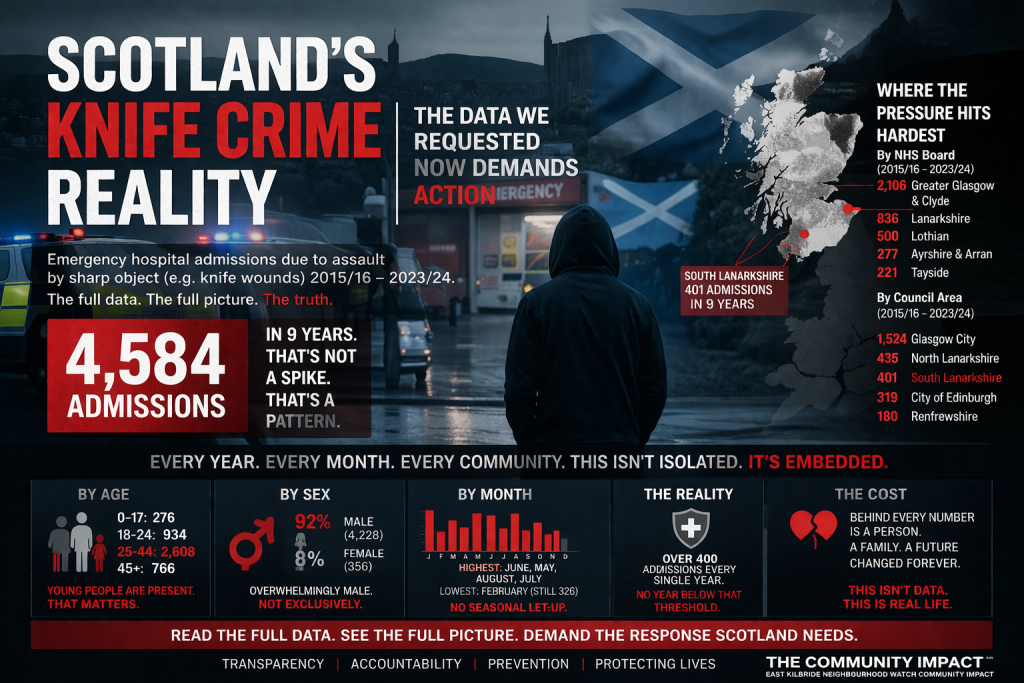
Public Health Scotland figures on emergency hospital admissions caused by assault by sharp object, such as knife wounds, show that Scotland continues to experience hundreds of serious incidents every year. In 2015/16 there were 562 such emergency admissions. That fell to 515 in 2016/17, rose again to 553 in 2017/18, and then climbed sharply to 667 in 2018/19, the highest figure in this dataset. After that, the numbers reduced to 542 in 2019/20, 496 in 2020/21 and 400 in 2021/22. Yet even after that fall, the trend has not continued cleanly downward. Admissions rose again to 408 in 2022/23 and 441 in 2023/24.
That matters. It shows that while Scotland is in a better position than in some earlier years, the trajectory is not one of simple or uninterrupted improvement. There has been genuine progress, but there are also signs of pressure returning.
The geographical picture is equally revealing. NHS Greater Glasgow and Clyde continues to account for the highest numbers, although it has seen a substantial reduction over time, from 284 admissions in 2015/16 to 169 in 2023/24. Glasgow City itself fell from 206 admissions in 2015/16 to 109 in 2023/24. That is important and should be recognised. It reflects how far the city has come from the years when knife violence was even more deeply embedded.
Yet Glasgow is not the only area that matters. NHS Lanarkshire recorded 98 admissions in 2015/16, 148 in 2018/19, 115 in 2019/20, 100 in 2020/21, then 59 in 2021/22, before rising again to 78 in 2022/23 and settling at 68 in 2023/24.
Looking specifically at council areas, South Lanarkshire recorded 40 admissions in 2015/16, climbed to 76 in 2018/19, dropped to 22 in 2021/22, then rose again to 43 in 2022/23 before falling back to 31 in 2023/24. North Lanarkshire showed a similar pattern, with figures fluctuating over time rather than disappearing.
That tells an important story for places like East Kilbride and the wider Lanarkshire area. The issue may not always dominate the national conversation, but it remains real enough to put people in hospital. These are not abstract statistics. They represent serious assaults, trauma, pressure on services and lives permanently altered in moments.
The age profile also matters. Across the period covered, the largest number of admissions consistently sits within the 25 to 44 age group. In 2023/24, that group accounted for 264 admissions, compared with 67 among 18 to 24 year olds, 26 among those aged 0 to 17, and 84 among those aged 45 and over. That confirms that the burden of serious knife related assault still falls most heavily on adults of working age.
But it would be a mistake to dismiss the younger figures. Even 26 admissions among children and teenagers is 26 too many, and the presence of any significant number in that group should concern all of us.
The sex breakdown is also stark. In 2023/24, 406 of the 441 emergency admissions were male, compared with 35 female. The pattern is consistent throughout the data. In 2018/19, for example, 613 of the 667 admissions were male. That underlines the relationship between knife violence, masculinity, trauma, social conditions and cycles of harm that have never been fully broken.
The monthly figures show there is no single season where the problem exists and another where it disappears. While some months are higher than others, admissions occur across the full year. In 2023/24, monthly totals ranged from 32 in April 2023 to 44 in May 2023, with most months sitting in the thirties. In other words, this is not a one off spike or a seasonal anomaly. It is a continuing public safety and public health issue.
What makes this especially important is that these figures measure emergency hospital admissions, not every knife related offence. They capture the cases serious enough to result in hospital treatment and discharge data from acute hospitals. They do not tell the full story of every threat, every possession offence, every near miss, or every incident that never makes it into the health data. They also come with caveats. PHS notes that a patient could have several admissions in a financial year, that some values are suppressed for confidentiality, and that completeness varies across health boards. The pandemic also affected trends and service activity. Even with those limitations, the figures remain deeply significant because they show the level of harm serious enough to require urgent medical care.
That is why the public health framing remains so important. Knife crime is not just about criminality in isolation. It is about trauma, poverty, environment, learned behaviour, inequality, fear, social breakdown and missed opportunities for intervention. It is about what happens long before someone ends up in A&E with a stab wound, and what happens long after.
Scotland’s earlier success came from recognising that reality. Violence was approached as something that spreads through conditions and exposure, and therefore something that can be interrupted. Early intervention, youth work, credible role models, school engagement, community trust, policing, family support and local campaigns all had a role to play. That model worked because it treated violence seriously without reducing it to punishment alone.
But public health success is not permanent. It has to be maintained. The admissions data shows that while Scotland is better than it once was, and in many respects better positioned than London, the issue has not gone away. It has changed shape. It has reduced in some places, fluctuated in others, and remains stubbornly present beneath the surface.
That is the danger of complacency. Once a place is seen as having solved the problem, attention moves on. Funding is stretched. Communities are expected to carry more with less. Warning signs are easier to miss. Yet the hospital data reminds us that serious violence continues to leave a trail of physical and emotional damage across Scotland every single year.
For communities like ours, this cannot be someone else’s issue. It is precisely why collective action matters. Support on the ground matters. Campaigning matters. Signposting matters. Speaking openly about violence, challenging its causes, and refusing to normalise it matters.
Because this work is not just about responding after the fact. It is about preventing the next admission, the next trauma, the next family receiving life changing news. Scotland has already shown that it can do better. The question now is whether we keep pushing forward, or allow the warning signs to become tomorrow’s crisis.
Behind every figure is a person. Behind every admission is a story. And behind every trend is a choice about whether we act early enough to change the outcome.
To read the full article please click register at the top of page.
contact@thecommunityimpact.co.uk
Leave a Reply
You must be logged in to post a comment.